

1031 Exchange
Defer capital gains with a 1031 exchange.
What a 1031 exchange is
Like-kind, into
American minerals.
A 1031 exchange lets you defer the capital gains tax on the sale of investment property by reinvesting the proceeds into other like-kind property. Under the U.S. tax code, oil and gas mineral and royalty interests can qualify as like-kind replacement property for real estate.
That means the proceeds from selling a building, a parcel of land, or another qualifying investment property can be exchanged into producing minerals while deferring the capital gains that a straight sale would trigger.

Why exchange into minerals
What a 1031 exchange into
minerals can provide.
Defer the capital gains
Exchanging qualifying property into like-kind minerals defers the capital gains tax a straight sale would trigger, so more of your proceeds stay at work.
Keep more capital invested
Because the gain is deferred rather than paid out at sale, a larger share of your proceeds can be reinvested in the replacement property.
Monthly royalty income
As oil and natural gas are produced and sold, owners receive monthly royalty income paid directly by the operator.
Long-term appreciation potential
As development continues and new wells come online, the value of mineral interests may increase over time without additional capital investment.
Exchange structures
Four ways to
structure an exchange.
Concurrent
Simultaneous
The property you sell and the like-kind replacement property close at the same time, in a single coordinated settlement.
Most common
Delayed (Forward)
You close on the property you are selling first, then acquire the replacement property within the IRS deadlines. Sometimes called a Starker exchange.
Replacement first
Reverse
A qualified intermediary acquires and holds the replacement property first; you sell your original property afterward, within the deadlines.
Improvement
Build-to-suit
Exchange proceeds are used to acquire and then improve the replacement property before the exchange is completed.

The timeline
How an exchange comes together.
- Before the sale
Engage a qualified intermediary
Current rules require a qualified intermediary to prepare the exchange agreement, hold the proceeds in escrow, and coordinate with the closing agents. Heritage connects you with one.
- Day 0
Sell your property
You close on the investment or business property you are relinquishing. Both the property you sell and the one you buy must be held for investment or business use.
- Day 45Hard IRS deadline
Identify within 45 days
From the date of sale, you have 45 calendar days to formally identify your replacement property, up to three candidates.
- Day 180Hard IRS deadline
Close within 180 days
You have 180 calendar days from the date of sale to close on the replacement minerals and complete the exchange.
These are general IRS rules and deadlines, summarized here for orientation. They are not tax or legal advice, and 1031 requirements changed under the 2017 Tax Cuts and Jobs Act. Work with a qualified intermediary and your own tax advisor before starting any exchange.
Want the full order of operations? Read the step-by-step 1031 exchange guide.
Eligible property
What you can exchange from.
If you hold real property for investment or business use, selling it may qualify for a 1031 exchange into minerals. Common examples include:
- Investment land
- Commercial buildings & warehouses
- Retail & shopping centers
- Apartments & multifamily
- Rental & investment homes
- Farms & ranches
- Self-storage facilities
- Hotels & motels
- Office buildings
- Parking & storage lots
- Conservation easements
- Oil, gas & mineral interests
Both the relinquished and the replacement property must be held for investment or business purposes. Personal-use property and, since the 2017 Tax Cuts and Jobs Act, personal property such as vehicles or collectibles no longer qualify.
Frequently asked questions
1031 questions, answered.
A few of the most common ones. See the full list, grouped by topic, on our FAQ page.
Investor voices
What investor partners say.
“I've worked with Don and his team at Heritage Land & Minerals on over five mineral properties. I've continued investing with them and have enjoyed how easy and straightforward they have made the process.”
Names abbreviated at investor request. Past performance is not indicative of future results.
Confidential Prospectus
Heritage Land & Minerals
Prospectus
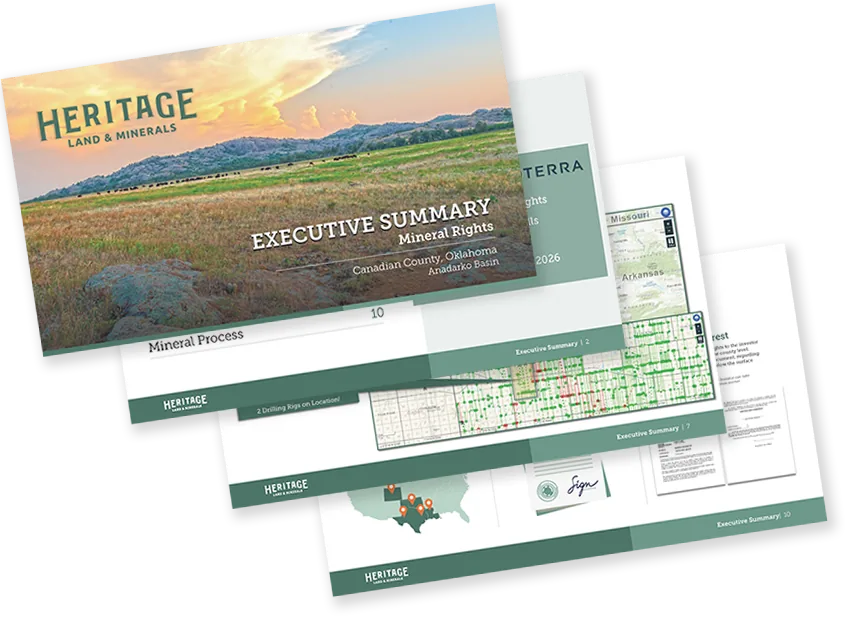
Current offerings, tax considerations, and a mineral acquisition overview.
- Current mineral and royalty offering details
- Why buy mineral rights, including tax benefits
- Location, well mapping, and surrounding production
- How purchasing works, step by step
1031 exchange clients receive this same prospectus. It covers the current offerings you can identify as replacement property.
 Request access below
Start your 1031 exchange
Selling investment property? Tell us where you are in the process and we will send the prospectus and walk through the timeline with you.
Risk disclosure
Mineral and royalty investments involve substantial risk, including the loss of principal. Distributions depend on production volumes, commodity prices, operator performance, and other factors outside Heritage's control, and are not guaranteed. Mineral and royalty interests are illiquid; there is no public market for them, and resale, including its price and timing, is not guaranteed. Heritage Land & Minerals offerings are available only to accredited investors and only by means of a confidential prospectus that contains the complete risk disclosure. This website is not an offer to sell or a solicitation of an offer to buy any security.