

Resources
Mineral & royalty glossary.
76 plain-English definitions for the terms you will run into when you own, buy, sell, or exchange mineral and royalty interests. For the bigger picture, start with understanding minerals and royalties, or browse the full resource library.
- API Number
- A unique identifying number for every oil and gas well drilled in the U.S. The system was developed by the American Petroleum Institute.
- Assignment
- The legal instrument by which oil and gas leases, royalty interests, or overriding royalty interests are assigned or conveyed.
- BOPD
- The abbreviation for barrels of oil per day.
- Bonus Payment
- A one time payment made by a lessee to a mineral owner for signing an oil and gas lease. Also called a lease bonus.
- Commercial Well
- A well that produces oil and/or gas in quantities sufficient that the proceeds from the sale of production exceed the directly related costs.
- Completion
- The process that takes place immediately after drilling is finished. It can involve setting casing, tubing, and packers, installing down-hole pumps or sand screens, and hydraulic fracturing.
- Cost Depletion
- One of the two methods the IRS allows for calculating the depletion allowance on oil and gas royalty revenue. The other method is percentage depletion.
- Decimal Interest (DOI)
- Your decimal interest represents your ownership share in a well or unit and is used to calculate your share of production revenue. It appears on your division order and revenue statements and determines the amount of royalty income you receive.
- Decline Curve
- The graphic representation of how a well's hydrocarbon production rate changes over time.
- Depletion
- With respect to oil and gas production, the process by which a producing reservoir is depleted, or produced, of its hydrocarbon.
- Depletion Allowance
- The tax deduction the IRS allows royalty and mineral owners to offset the decrease in value of a capital investment caused by the production, or depletion, of minerals.
- Developmental Well
- A well drilled to a known producing formation in an existing oil field.
- Discovery Well
- The first oil or gas well drilled in a new field, which reveals the actual presence of a petroleum-bearing reservoir. Subsequent wells are called development wells.
- Division Order
- A schedule of owners and their decimal ownership share in the revenues from a well's production.
- Division Order Title Opinion
- An opinion, generally written by an attorney, stating the names and decimal ownership interests within a producing oil or gas well, unit, or lease.
- Easement
- A created interest that allows the use of land for a stated purpose. In oil and gas this is most commonly for installing and operating pipelines.
- Executive Rights to Minerals
- The rights to negotiate and execute oil and gas leases, lease bonuses, and delay rentals. Executive rights are usually referenced when a non-participating royalty interest exists, and are held by the owner of the mineral fee estate.
- First Right of Refusal
- A provision stating that the operator has the right to top-lease before any third party does. In effect it is an option to review and preempt a transaction by another party.
- Flush Production
- The initial surge of production that usually comes from a well right after it is first completed and put on line. This flow rate is typically much higher than the rate that will be sustained, and is sometimes called the peak flow rate.
- Formation
- A geological term for a separate layer of rock or a group of intermingled beds.
- Fracking (Hydraulic Fracturing)
- The process of using high pressure to pump sand-laden gelled fluid into subsurface rock formations in order to improve flow into a well bore. Also called fracturing, fracing, or a frac job.
- Grantee
- The person receiving lands, minerals, or other interests.
- Grantor
- The person who grants or conveys lands, minerals, or other interests.
- Gross Acres
- The total number of surface acres in a tract before ownership percentages are applied.
- Held By Production (HBP)
- A lease that remains in effect because oil or natural gas is being produced in paying quantities.
- Horizontal Drilling
- A well in which a portion is drilled horizontally to expose more of the formation's surface area to the well bore.
- Hydrocarbon
- An organic chemical compound of hydrogen and carbon, called petroleum. The molecular structure ranges from the simplest, methane, a constituent of natural gas, to the very heavy and complex.
- Infill Drilling
- Wells drilled to fill in between established producing wells on a lease.
- Initial Production
- The rate of initial flow from a well.
- Lease
- The generic name for an oil, gas, and mineral lease (OGML).
- Lessee
- The purchaser, or taker, of an oil, gas, and mineral lease.
- Lessor
- The party who grants an oil, gas, and mineral lease.
- Mineral Lease
- An instrument that sets out the terms by which one party leases the right to explore for and produce certain minerals within a specific tract of land. In oil and gas this is sometimes called an oil, gas, and mineral lease (OGML).
- Mineral Owner
- The owner of the rights and interests in a mineral estate, where interests in a landed estate have been severed, along with the right to execute a lease on the same.
- Mineral Rights
- Ownership of the minerals on or under the surface, with the owner having the right to recover them or to delegate that right to another party by negotiating a lease agreement.
- Mineral Title
- The legal ownership of the mineral estate, generally referenced in association with a particular tract of land.
- Net Mineral Acre (NMA)
- One acre of mineral rights owned at a 100% mineral interest. Net mineral acres are used to measure ownership regardless of tract size.
- Net Revenue Interest (NRI)
- An owner's interest in the revenues of a well.
- Net Royalty Acre (NRA)
- A standardized unit of measure representing the right to a 1/8 (12.5%) royalty from one gross acre. It allows mineral interests with different royalty rates to be compared and valued on an equal basis.
- Non-Producing Mineral Owner
- An owner of minerals that are not currently being produced and sold.
- Oil & Gas Mineral Lease
- The agreement outlining the basic terms of developing lands or minerals, such as the royalty to be paid, the length of time, and a description of the lands.
- Operator
- The company responsible for drilling, producing, and operating an oil and gas well. The operator distributes royalty payments to owners.
- Overriding Royalty Interest (ORRI)
- A royalty interest created from a working interest that entitles the owner to a share of production revenue without paying drilling or operating costs. An ORRI does not affect the mineral owner's ownership interest.
- Participating Royalty Interest
- A royalty interest giving its owner the right to participate in bonuses received and in any oil or gas found.
- Permitted Well
- A well that has received regulatory approval to be drilled but has not yet begun production.
- Pooled Unit
- A unit created by combining separate mineral interests under the pooling clause of a lease or agreement.
- Producer
- A producer of oil and gas, sometimes also called an operator or the oil company.
- Producing Mineral Interests
- A mineral interest on which production is actively taking place and minerals are being removed and marketed. Oil and gas leases often require commercial quantities for a lease to continue.
- Producing Mineral Owner
- An owner of minerals that are currently being produced and sold. Payments made to these owners are known as royalty payments, or royalties.
- Producing Property (PDP)
- A property with one or more wells that are currently producing and generating royalty income.
- Proven Reserves
- Oil or gas that has not yet been produced but has been located and is economically recoverable. The term refers to reserves with a 90 percent (P90) or better probability of being produced in the current environment.
- Qualified Intermediary
- An advisor who prepares documents and ensures proper handling of funds in a 1031 exchange.
- Reservoir
- A porous, permeable sedimentary rock containing oil and gas.
- Reservoir Engineering
- The application of scientific and engineering principles to production from a developed reservoir for maximum economic return.
- Revenue Statement
- The monthly statement sent by the first purchaser or the operator to the interest holders in a producing property, detailing the production volumes and pricing for the hydrocarbons produced and sold each month.
- Royalty
- Revenue generally received by a mineral owner from the production of oil or gas, free of costs except taxes.
- Royalty Interest
- The right to receive a share of the revenue from oil and natural gas produced from a property without paying the costs of drilling or operating the wells.
- Royalty Percentage
- The percentage of gross or net production paid to the mineral owner, usually described as a fraction such as 1/8, 3/16, 1/6, 1/5, or 1/4.
- Royalty Statement
- An account of finances detailing a well's production and the prices received. Mineral owners receive these monthly or as revenue crosses certain thresholds, depending on the state and operator.
- Secondary Recovery
- Enhanced recovery of oil or gas beyond what normal flowing and pumping can produce, by maintaining or boosting reservoir pressure through injecting water, gas, CO2, or other substances into the formation.
- Severance
- The separation of a mineral or royalty interest from the other interests in a piece of land.
- Severance Tax
- A state tax levied against both royalty and working-interest owners on their pro-rata share of oil and gas production. Each state sets its own rates and often has special provisions for low-rate or secondary-recovery wells.
- Severed Minerals
- Minerals whose title has been severed from the surface title.
- Shut-In Royalty
- A payment to royalty owners under the terms of a lease that lets the lessee defer production from a well capable of producing but shut in for lack of a market.
- Spud Date
- The date drilling officially begins on a well.
- Surface Estate
- The rights and interests in the surface of land, as opposed to the mineral estate.
- Surface Owner
- The owner of the rights and interests in a surface estate.
- Surface Rights
- The set of rights associated with the surface of the land only, as distinguished from mineral rights.
- Three-Dimensional (3-D) Seismic
- An advanced method for collecting, processing, and interpreting seismic data in three dimensions, gathered from closely spaced lines over an area of interest. It offers increased resolution and improved interpretation tools and data displays.
- Title Abstract
- A chronological history of the ownership of, or significant events affecting, a particular piece of property.
- Title Curative
- Measures taken to fix defects in the chain of title, including correcting instruments and reconciling title with the use and possession of the land.
- Undeveloped Acreage
- Lease acreage on which wells have not been drilled or completed to a point that would permit the production of commercial quantities of oil and gas.
- Unit (Spacing Unit)
- The acreage assigned to a well for allocating production among mineral owners. A unit may contain one or multiple tracts of land.
- Unitization
- Joint operations to maximize recovery among separate operators within a common reservoir. Also called a unitization agreement or unit agreement.
- Well Site
- The physical location on which an oil or gas well is drilled, generally ranging from about half an acre to two acres depending on the footprint of the production facilities needed.
- Working Interest (WI)
- An ownership interest that shares in the costs of drilling and operating a well in exchange for a share of production revenue. Unlike royalty interests, working interest owners pay their proportionate share of expenses.
Confidential Prospectus
Heritage Land & Minerals
Prospectus
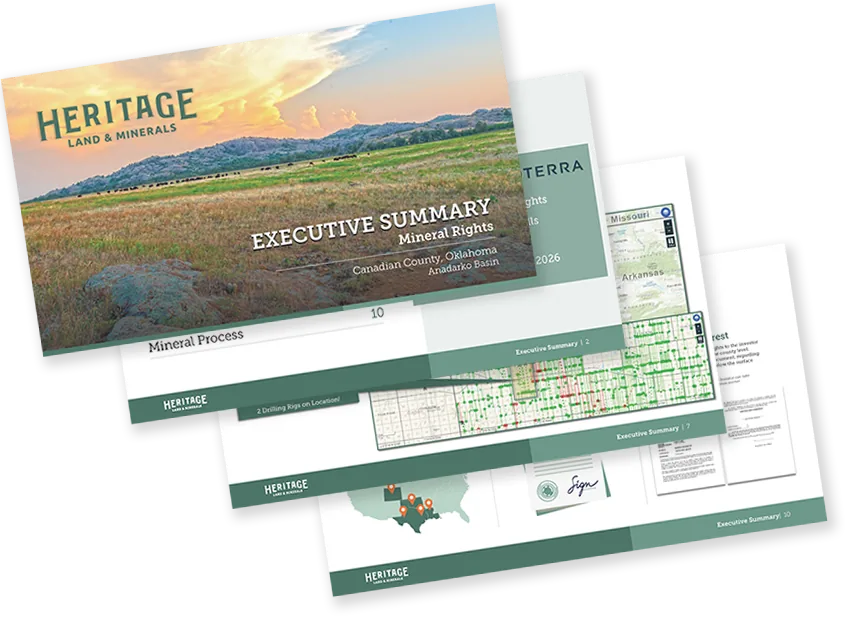
Current offerings, tax considerations, and a mineral acquisition overview.
- Current mineral and royalty offering details
- Why buy mineral rights, including tax benefits
- Location, well mapping, and surrounding production
- How purchasing works, step by step
 Request access below
Request access to current offerings
If you're an accredited investor exploring oil and gas investments, we're ready to discuss fit and share our current prospect details.
Risk disclosure
Mineral and royalty investments involve substantial risk, including the loss of principal. Distributions depend on production volumes, commodity prices, operator performance, and other factors outside Heritage's control, and are not guaranteed. Mineral and royalty interests are illiquid; there is no public market for them, and resale, including its price and timing, is not guaranteed. Heritage Land & Minerals offerings are available only to accredited investors and only by means of a confidential prospectus that contains the complete risk disclosure. This website is not an offer to sell or a solicitation of an offer to buy any security.