

The Library
Knowledge for mineral owners.
The library
Guides, insights, and
answers for owners.
Explore practical guides, articles, and answers covering mineral ownership, royalties, Section 1031 exchanges, and more. Whether you are just getting started or looking to learn more, our library is built to help.
Featured
Heritage Investor Prospectus
Our current mineral and royalty offerings, tax considerations, and a mineral acquisition overview. Available to accredited investors; we confirm fit before sending.
Request accessMore guides and market insights will appear here as they are published. In the meantime, browse the glossary and the common questions below.
Reference
The mineral & royalty
glossary.
Our glossary explains the terms you'll encounter when owning, buying, or selling mineral and royalty interests. From division orders and leases to royalty statements and title documents, each definition is written in plain English to help you better understand your ownership.
- Royalty Interest
- The right to receive a share of the revenue from oil and natural gas produced from a property without paying the costs of drilling or operating the wells.
- Decimal Interest (DOI)
- Your decimal interest represents your ownership share in a well or unit and is used to calculate your share of production revenue. It appears on your division order and revenue statements and determines the amount of royalty income you receive.
- Held By Production (HBP)
- A lease that remains in effect because oil or natural gas is being produced in paying quantities.
- Overriding Royalty Interest (ORRI)
- A royalty interest created from a working interest that entitles the owner to a share of production revenue without paying drilling or operating costs. An ORRI does not affect the mineral owner's ownership interest.
Frequently asked questions
The questions owners and investors ask most.
A few of the most common ones. See the full list, grouped by topic, on our FAQ page.
Investor voices
What investor partners say.
“I've worked with Don and his team at Heritage Land & Minerals on over five mineral properties. I've continued investing with them and have enjoyed how easy and straightforward they have made the process.”
Names abbreviated at investor request. Past performance is not indicative of future results.
Confidential Prospectus
Heritage Land & Minerals
Prospectus
Current offerings, tax considerations, and a mineral acquisition overview.
- Current mineral and royalty offering details
- Why buy mineral rights, including tax benefits
- Location, well mapping, and surrounding production
- How purchasing works, step by step
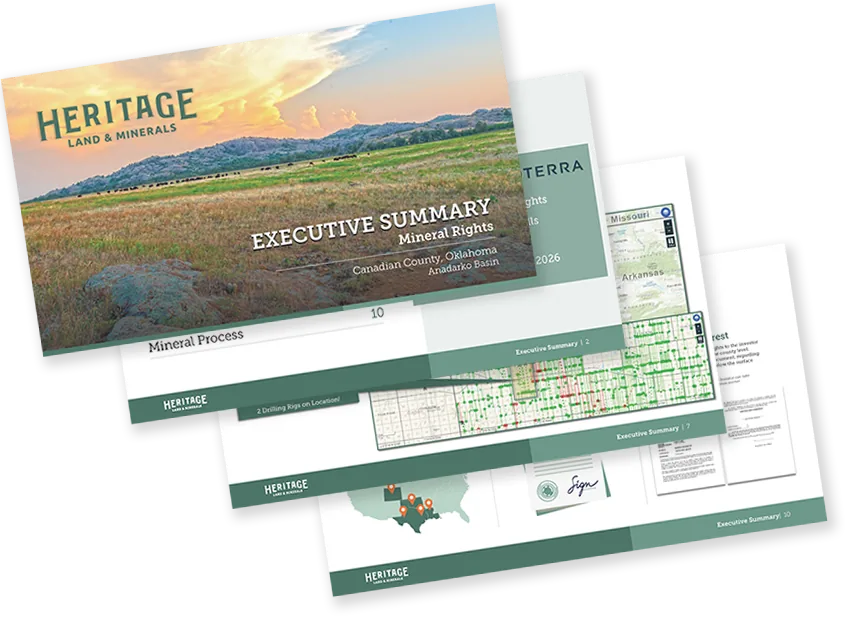 Request access below
Request access to current offerings
If you're an accredited investor exploring oil and gas investments, we're ready to discuss fit and share our current prospect details.
Risk disclosure
Mineral and royalty investments involve substantial risk, including the loss of principal. Distributions depend on production volumes, commodity prices, operator performance, and other factors outside Heritage's control, and are not guaranteed. Mineral and royalty interests are illiquid; there is no public market for them, and resale, including its price and timing, is not guaranteed. Heritage Land & Minerals offerings are available only to accredited investors and only by means of a confidential prospectus that contains the complete risk disclosure. This website is not an offer to sell or a solicitation of an offer to buy any security.